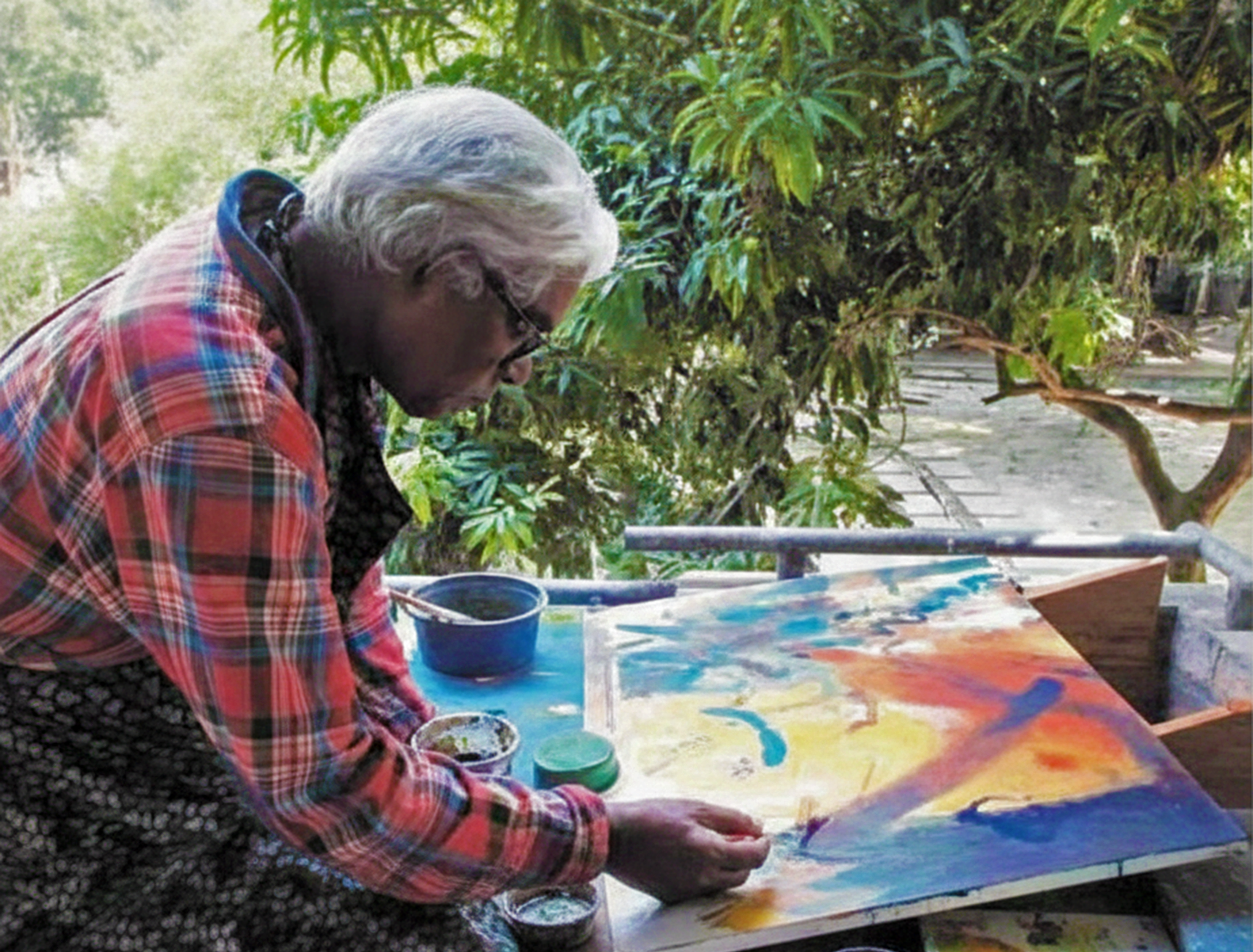
Monsur Ul Karim
1950 – 2020

Monsur Ul Karim stands among Bangladesh’s seminal modern painters, renowned for transforming the natural landscape into a deeply expressive, abstract visual language. Born in 1950 in Rajbari, Karim came of age during a period of profound social and cultural change in the newly independent nation. He trained at the Faculty of Fine Arts, University of Dhaka, where he absorbed the formal techniques of modernist painting while cultivating a personal aesthetic that would later distinguish him as a pioneer of lyrical abstraction in Bangladesh.
Karim’s work is characterized by its ethereal, atmospheric quality, often evoking the shifting moods of rivers, fields, and skies. His layered palettes, textural brushwork, and flowing compositions suggest not only physical landscapes but also psychological and spiritual terrains. These paintings blur the line between memory and perception, inviting viewers to inhabit a world that is both familiar and metaphysically resonant. Through his exploration of colour, form, and light, Karim articulated an intimate dialogue between nature, emotion, and cultural memory.
Over decades, Karim exhibited widely across Bangladesh and internationally, representing the nation in numerous group exhibitions and biennales. His paintings are included in the collections of the Bangladesh National Museum, Shilpakala Academy, and major private collectors worldwide. Critically, his work is celebrated for balancing formal experimentation with a deeply meditative, emotional engagement, reflecting his belief in art as a conduit for both personal and collective memory.
Beyond his studio practice, Monsur Ul Karim was a dedicated educator. He taught at the University of Chittagong and the University of Development Alternative (UODA), shaping generations of contemporary artists through his mentorship and insight. His pedagogical approach emphasized technical mastery, thoughtful observation, and the integration of cultural identity into abstract expression.
Monsur Ul Karim’s legacy is inseparable from the evolution of Bangladeshi modern art. His innovative abstraction, rooted in both natural and cultural landscapes, continues to inspire artists, collectors, and scholars. He left behind a body of work that is at once serene, dynamic, and profoundly human, reflecting the enduring power of painting to navigate memory, emotion, and the timeless rhythms of the Bengal environment.